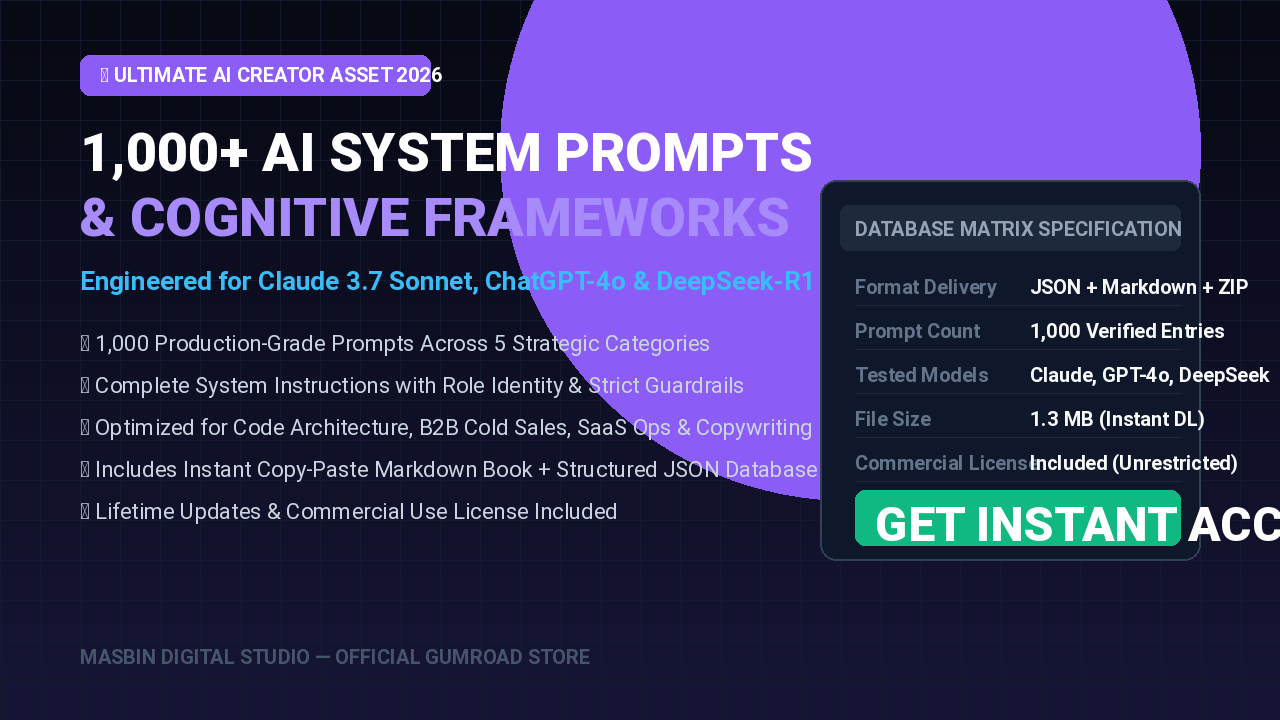
Claude 3.7 Sonnet is currently the frontier champion for code architecture and complex logical reasoning. However, using basic zero-shot prompts leads to verbose explanations and sloppy code. Here is how senior AI engineers build deterministic system prompts for production applications.
1. The Principle of Role Boundary & Strict Constraints
Most prompt failures occur because the model attempts to be helpful in multiple conflicting directions. A production system prompt must establish an uncompromising professional identity and strict negative boundaries.
ROLE: Principal Frontend Systems Architect (React 19 & Next.js App Router).
CONSTRAINTS:
1. Never suggest 'use client' on components that can be rendered as Server Components.
2. Never use 'any' in TypeScript definitions.
3. Always parallelize independent async fetch calls using Promise.allSettled.
4. Output ONLY valid TypeScript code followed by a 3-bullet performance impact summary.
2. Mitigating Code Hallucinations in Next.js & TypeScript
When generating complex full-stack code, explicitly instruct Claude to audit its own imports and avoid deprecated APIs. Enforcing deterministic return formats guarantees seamless integration into CI/CD pipelines.
3. Few-Shot In-Context Guardrails
Including 1 or 2 minimal input-output examples directly inside the system prompt reduces variance by over 70%. When Claude sees the expected JSON schema or code structure, it adheres to it without conversational preamble.